
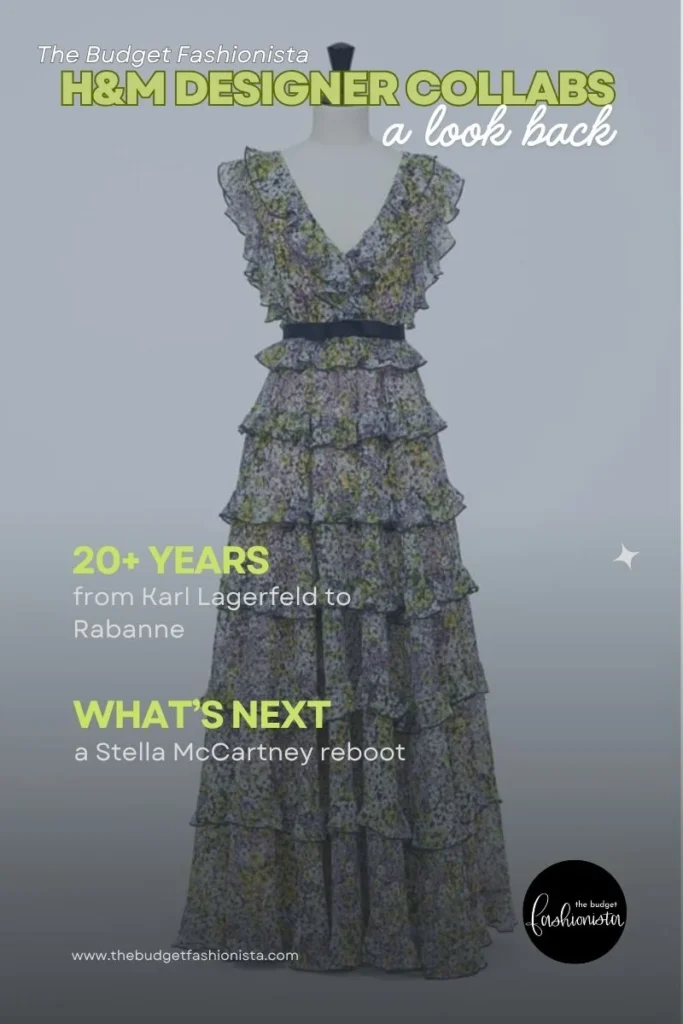
H&M announced it’s reuniting with Stella McCartney for a 2026 collection hitting stores in May. The first time they teamed up was back in 2005 — the second drop in what became one of fashion’s most reliable experiments.
I used to buy the trend first and ask questions later, and those early collabs were my gateway drug. A Karl Lagerfeld blazer at a price that didn’t make me panic? That was the moment I started paying attention.
The 2026 reboot gives us a good reason to revisit the full timeline. Here’s everything worth remembering from twenty years of H&M designer collaborations.
{{image:cover.webp}}
Early collab years: 2004–2008
H&M launched its first designer collection in 2004. The high-low strategy was still new, and budget shoppers warmed to it fast.
2004: Karl Lagerfeld. Sleek tailoring, sharp silhouettes, a monochrome palette that carried unmistakable Chanel energy. Lagerfeld was the creative director there at the time, and you could feel it in every piece. Shop Karl Lagerfeld x H&M on Poshmark
2005: Stella McCartney. Feminine, wearable, softly tailored with a modern simplicity that still holds up today. Shop Stella McCartney x H&M on Poshmark
2006: Viktor & Rolf. Playful and conceptual — artistic without being impractical. These pieces had an edge but remained wearable for everyday shoppers. Shop Viktor & Rolf x H&M on Poshmark
2007: Robert Cavalli. Nightlife energy, bold prints, metallics. The kind of glam party pieces that made a weeknight feel like an event. Shop Robert Cavalli x H&M on Poshmark
2008: Comme des Garçons. Avant-garde tailoring, unexpected shapes, and polka dots that pushed everyone slightly outside their comfort zone. Shop Comme des Garçons x H&M on Poshmark
Gaining momentum: 2009–2014
The annual drops started inspiring real frenzy. Shoppers lined up for affordable Jimmy Choos and pieces that felt collectible rather than disposable.
Spring 2009: Matthew Williamson. A colorful, boho-luxe collection with bold prints and breezy silhouettes — vacation dressing you could actually afford.
Autumn 2009: Jimmy Choo. Statement accessories, party-ready heels and bags. Designer footwear within reach for the first time. Shop Jimmy Choo x H&M on Poshmark
Spring 2010: Sonia Rykiel. Playful knits, stripes, Parisian charm. A cozy-meets-chic collection with a distinctly feminine edge. See the Sonia Rykiel x H&M collection
Autumn 2010: Lanvin. Romantic dresses, luxe-looking fabrics, polished tailoring. High fashion that felt surprisingly wearable.
2011: Versace. Bold patterns, body-conscious silhouettes, unmistakable drama at H&M prices.
Spring 2012: Marni. Quirky prints, layered styling, slightly offbeat proportions for shoppers who wanted something different.
Autumn 2012: Maison Martin Margiela. Conceptual and archival-inspired — oversized shapes and deconstructed details that felt more collectible than everyday.
2013: Isabel Marant. Effortless Parisian style with relaxed fits and boho touches. The kind of separates you’d rotate through your closet all season long.
2014: Alexander Wang. Sporty, minimalist, athletic edge. It blurred the line between streetwear and performance wear before that became a category everyone talked about.
The social media era: 2015 onward
Social media propelled these collections to new heights. While H&M faced growing criticism for its quick-turn production, the designer drops kept drawing attention — and lines around blocks.
2015: Balmain. Ultra-glam, heavily embellished pieces with strong shoulders and celebrity-driven hype that defined an entire era of collabs.
2016: KENZO. Loud, bold, unapologetically fun. Statement silhouettes that felt energetic and youthful.
2017: Erdem. Romantic florals and vintage-inspired shapes — softer, more delicate, occasion-ready without being fussy.
2018: Moschino. Playful, logo-heavy pieces with pop culture references and a tongue-in-cheek attitude that made fashion feel like an inside joke.
2019: Giambattista Valli. Dramatic tulle dresses and elevated evening wear. Red-carpet energy at H&M pricing. See the Giambattista Valli x H&M pieces
2021: Simone Rocha. Intricate, feminine designs with pearls, volume, and craftsmanship that felt special and collectible.
2021: Toga Archives. Eclectic, layered pieces with hardware details and a cool, offbeat styling perspective.
Spring 2023: Mugler. Body-contouring silhouettes, sheer panels, bold tailoring. Confidence and structure in every seam.
Autumn 2023: Rabanne. Metallics, chainmail, party-ready pieces leaning into futuristic glamour and statement dressing.
In 2024, H&M celebrated twenty years of designer collabs by re-releasing pre-owned pieces from prior collections — a nod to sustainability without abandoning what works.
Why high-low collaborations matter
I rely on these launches for one thing: high-style statement pieces that don’t break the budget. They’re also an affordable way to experiment with a designer aesthetic before committing to the real price tag.
There are trade-offs, of course. Compared to true designer pieces, the materials tend toward the lower end and exclusivity is limited. These collections sell out fast, but they won’t hold value like a Chanel bag would.
If quality matters more than label to you, H&M Studio or H&M Premium Selection are worth checking first — upgraded fabrics, cleaner styling, higher price points than standard pieces.
Smart shopping rules still apply
The collections that launch with the most buzz tempt you into breaking your own rules. Don’t do it. If you want to buy a Stella McCartney x H&M piece this spring, demand something you’ll wear multiple ways.
Gift yourself a fashion workhorse — one that happens to carry Stella McCartney’s name on the tag.
FAQ
When is the 2026 Stella McCartney x H&M collection arriving?
May 2026.
Which H&M designer collab was the first?
The Karl Lagerfeld collection in 2004.
Do H&M collaboration pieces hold their value?
They sell out quickly but don’t retain resale value the way true designer pieces do. Think of them as affordable access to a design aesthetic, not an investment purchase.
A note from Maya: I still have the Viktor & Rolf blouse from 2006 sitting in my closet. Not because it’s flawless — but because some pieces earn their shelf space simply by reminding you what fashion felt like when surprise was part of the deal.